Sleep Sanity
The Ferber method, explained: the check-in chart, night by night
What the Ferber method actually is, the progressive waiting chart from Dr. Ferber's book, what to do at each check-in, how long it usually takes, and when to wait.
The Ferber method is the best known form of sleep training, and also the most misunderstood. Half the internet thinks it means leaving a baby to cry alone all night. It does not. This guide covers what Dr. Richard Ferber actually described, the exact waiting chart from his book, what you do during a check-in, and how to tell whether it is working.
What the Ferber method is
Dr. Richard Ferber is a pediatrician who ran the sleep clinic at Boston Children's Hospital. In 1985 he published Solve Your Child's Sleep Problems, revised in 2006. The approach in that book is usually called the Ferber method. In research papers it is called graduated extinction. Parents call it check and console, or progressive waiting, which is Ferber's own term.
The idea is simple. Babies who are rocked or fed to sleep learn that this is how falling asleep works. When they surface between sleep cycles at night, which every human does, they need the same help to get back down, so they call for it. Ferber's method teaches a baby to fall asleep on their own at bedtime, so they can do the same thing at 2am without you.
The method has three parts:
- A calm, consistent bedtime routine, ending with your baby put down in the crib awake.
- If your baby cries, you wait a set number of minutes, then go in for a brief check-in: a calm voice, maybe a pat, no picking up, no feeding, and out again within a minute or two.
- The waits get longer through the night, and longer again each night.
The check-ins are the whole point. Your baby learns that you are still there and that nothing is wrong, while also getting the chance to practise settling. This is what separates the Ferber method from full extinction, which most parents call cry it out, where you do not go back in at all.
The Ferber method chart
This is the progressive waiting table from the 2006 edition of the book. Each number is how many minutes you wait before a check-in. After the third check-in on any night, keep repeating that night's longest wait until your baby is asleep.
| Night | First wait | Second wait | Every wait after that |
|---|---|---|---|
| Night 1 | 3 min | 5 min | 10 min |
| Night 2 | 5 min | 10 min | 12 min |
| Night 3 | 10 min | 12 min | 15 min |
| Night 4 | 12 min | 15 min | 17 min |
| Night 5 | 15 min | 17 min | 20 min |
| Night 6 | 17 min | 20 min | 25 min |
| Night 7 | 20 min | 25 min | 30 min |
A few things parents miss about this chart:
- The waits reset at every waking. If your baby wakes at 1am on night 2, you start again at 5 minutes, not at 12.
- The minutes are a ceiling, not a target. Ferber was explicit that you can use shorter waits if the chart feels too hard. What matters is that the waits are consistent and get gradually longer.
- You can stop the clock. If the crying stops, or drops to grumbling, do not go in. A check-in at the wrong moment can wake a baby who was nearly asleep.
- Night 8 onward is not in the chart. Most babies are settling well by then. If not, stay at the night 7 intervals rather than pushing them longer.
If counting minutes at 2am sounds like the worst part, that is because it is. Our free Ferber method timer runs the chart for you, and the Sleep Sanity app does it every night with its own gentler ladder.
What to do at a check-in
The check-in is short and boring on purpose. You are there to reassure, not to settle.
- Go in calmly. Keep the lights off or very low.
- Say the same quiet phrase every time. Something like "It's sleep time, I love you, goodnight."
- A brief touch or pat is fine. Do not pick your baby up, rock them, or feed them. If you do, the check-in has become the thing they are waiting for.
- Stay for 1 to 2 minutes at most, even if the crying gets louder while you are there. It usually does.
- Leave while your baby is still awake. That is the skill being practised.
Many parents find the first two nights easier with a hands on check-in (a pat on the chest) and later nights easier with voice only from the door. The app follows the same pattern: touch for nights 1 and 2, voice from night 3.
How long it takes
Ferber's book, and the studies that followed, describe most babies falling asleep faster and waking less within three to seven nights. The hardest night is usually night 2 or 3, not night 1, because your baby has now realised the new rules are real. There is often a bump again around day 5 to 7, sometimes called an extinction burst, where things get briefly worse right before they settle.
Two honest caveats. First, it works for most families, not all. Second, consistency is doing most of the work. A family that follows the chart loosely for two weeks usually has a harder time than a family that follows it exactly for five nights.
Keep a simple log so you can see the trend rather than relying on how last night felt. Time to fall asleep, number of wakes, and the longest stretch are the three numbers that matter. What a sleep score means explains how the app turns those into one number each morning.
Is the Ferber method safe?
This is the question every parent asks, and it deserves a straight answer rather than reassurance.
Behavioural sleep training, including graduated extinction, is one of the most studied things in infant sleep. A 2006 review commissioned by the American Academy of Sleep Medicine looked at 52 studies and found these methods effective, with no evidence of harm. A 2012 Australian study followed children five years after sleep training and found no difference in emotional health, behaviour, stress, or the parent and child relationship compared with children who were not sleep trained. A 2016 randomised trial measured infant cortisol and attachment after graduated extinction and found no signs of stress or attachment problems.
What the research does not do is tell you whether it is right for your family. Some parents are not comfortable with any crying and prefer a slower approach, and that is a valid choice. Sleep training methods compared walks through the gentler alternatives.
When to start
Ferber suggested that most babies are ready from around 5 or 6 months, once they can go a long stretch without a feed and have a reasonably predictable day. Many pediatricians are comfortable from 4 months for a modified, gentler version. Before 4 months, sleep is still too disorganised for a method like this to make sense.
Do not start during illness, teething that is clearly painful, the week of a move, or right as a new daycare begins. Pick a stretch of at least five nights where both parents can be consistent. When to start sleep training covers the readiness signs in more detail.
Night feeds
The Ferber method does not require you to stop night feeds. If your baby still needs one or two, keep them, but make them boring: dim light, feed, straight back down awake. The point is that feeding stops being how your baby falls asleep.
If you and your pediatrician agree your baby is ready to drop night feeds, a gradual taper works better alongside sleep training than stopping cold. How to night wean has a night by night schedule.
Common mistakes
- Putting the baby down already asleep. Then the method cannot work, because the skill never gets practised. Drowsy but awake means awake.
- Check-ins that turn into settling. If you stay until the crying stops, your baby learns that crying for long enough brings you back for good.
- Giving up on night 3. The hardest night is often the one right before the breakthrough.
- Different rules on different nights, or between parents. Both parents should know the plan and follow the same intervals. Shared logging helps here, which is why the app syncs both phones.
- Wrong timing in the day. A baby who is overtired or not tired enough at bedtime will protest far more. Check the wake windows for their age before you blame the method.
More on the Ferber method
- Ferber method not working? The eight reasons to check
- The Ferber method for naps and the 30 minute rule
- How long to let a baby cry, by method and age
- Cry it out vs the Ferber method
- Sleep training a 4 month old and a 6 month old
- Toddler sleep training and early morning wakes
- Print the Ferber chart or run the free timer
FAQ
Is the Ferber method the same as cry it out?
No. Cry it out usually means full extinction: you put your baby down and do not return until morning or until a set wake time. The Ferber method has timed check-ins throughout, so your baby is never left indefinitely. Ferber himself objected to the cry it out label.
How many minutes do you wait with the Ferber method?
On night 1 you wait 3 minutes, then 5, then 10 for every wait after that. The waits grow each night, reaching 20, 25 and 30 minutes by night 7. The full chart is in this guide, and shorter waits are fine as long as they are consistent.
Can you do the Ferber method for naps?
Yes, with a limit. Ferber suggested trying for up to 30 minutes at nap time. If your baby has not fallen asleep by then, get them up, keep them awake until the next nap or an earlier bedtime, and try again. Most families fix nights first and naps a week or two later.
Does the Ferber method work for a 4 month old?
Many pediatricians are comfortable with a gentle version from 4 months, with short waits and no pressure to drop feeds. Ferber's own guidance leans toward 5 to 6 months. Ask your pediatrician, and be prepared to pause if your baby is clearly not ready.
What if my baby throws up?
It happens occasionally with hard crying. Go in, clean up calmly and quietly, change what needs changing, then continue the plan. Making it a big event tends to teach that vomiting brings a long cuddle, which is the opposite of what anyone wants.
What does the Sleep Sanity app do differently?
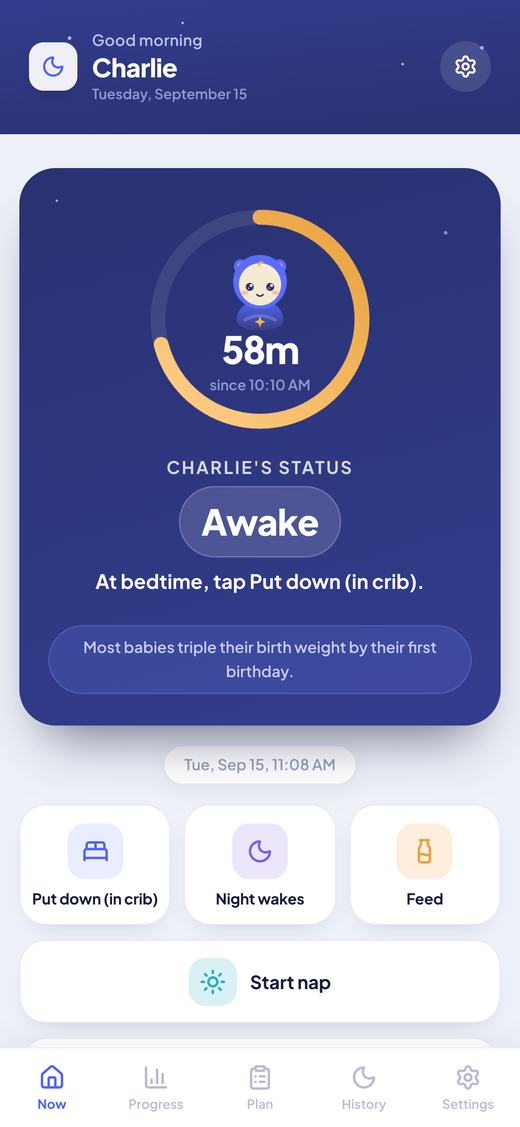
The app is Ferber style but uses its own ladder: 5 minutes, then 15, then 30, then every 15 minutes, the same every night, with touch check-ins for the first two nights and voice after that. It logs the night in one tap, counts the intervals and tells you when the next check-in is due. You can also follow the classic chart with our free timer.
Sources
- Ferber, R. Solve Your Child's Sleep Problems, revised edition (Simon and Schuster, 2006)
- Mindell JA et al. Behavioral treatment of bedtime problems and night wakings in infants and young children. Sleep, 2006
- Price AM et al. Five year follow up of harms and benefits of behavioral infant sleep intervention. Pediatrics, 2012
- Gradisar M et al. Behavioral interventions for infant sleep problems: a randomized controlled trial. Pediatrics, 2016
- American Academy of Pediatrics, HealthyChildren.org: Getting your baby to sleep
- Canadian Paediatric Society, Caring for Kids: Healthy sleep for your baby and child
Sleep Sanity is informational, not medical advice. Talk to your pediatrician before starting any sleep-training approach.
More from Learn
When to start sleep training: age, readiness signs and the weeks to avoid
The age most pediatricians suggest, the signs your baby is ready, the situations that make a bad week to start, and what to do if you are not there yet.
Read 7 min readToddler sleep training: 12 months to 3 years, including the crib climber
How sleep training changes after the first birthday: the one nap schedule, bedtime stalling, standing and climbing, the toddler bed question, and a check-in plan that works for toddlers.
Read 8 min readSleep training methods compared: Ferber, chair, pick up put down, fading and extinction
The five main sleep training methods side by side, how much crying each involves, how long each usually takes, and how to pick one your family can actually stick to.
ReadTonight can be the first better night.
Two taps from here to logging. No account, no card, no setup beyond your baby's name.

Free. No ads. No in app purchases.Or use it in your browser