Sleep Sanity
When to start sleep training: age, readiness signs and the weeks to avoid
The age most pediatricians suggest, the signs your baby is ready, the situations that make a bad week to start, and what to do if you are not there yet.
The honest answer to "when should I start sleep training" is: when your baby is old enough, your pediatrician is comfortable, and you have a clear week ahead. This guide puts numbers and specifics on each of those.
The short answer by age
| Age | What is realistic |
|---|---|
| 0 to 3 months | No formal sleep training. Work on day and night differences, a simple routine, and safe sleep. |
| 4 months | Gentle methods only, with your pediatrician's OK. Short waits, keep night feeds. |
| 5 to 6 months | The age most pediatricians and most of the research point to. All methods are on the table. |
| 7 to 12 months | Still a good window. Separation awareness can make check-ins harder, so expect louder protests. |
| 12 months and up | Works, but habits are more set and toddlers can stand and negotiate. Expect it to take a little longer. |
There is no deadline. Plenty of families start at 10 months or 18 months and get there. The window that tends to be easiest is 5 to 7 months, which is why the Sleep Sanity plan starts from 4 months and is built around that stretch.
Why not before 4 months
Newborn sleep is not disorganised because of habits. It is disorganised because the parts of the brain that regulate sleep cycles and the day night rhythm are still being built. Before about 4 months, babies also genuinely need to feed at night, and many are not able to self settle no matter what you do. Sleep training at this age mostly adds crying without changing the outcome.
What does help in the first months: light and activity during the day, dark and boring nights, a short and repeatable bedtime routine, and putting your baby down drowsy when it works, without stressing when it does not.
Signs your baby is ready
Age is a rough guide. These matter more:
- A predictable day is forming. Naps and feeds happen at roughly similar times, even if not on the clock.
- They can go a long stretch between feeds. Usually 6 hours or more at least some nights, and weight gain is on track. Your pediatrician can confirm this.
- The 4 month sleep regression has passed. If sleep just fell apart in the last two weeks, that is probably the 4 month regression, and it is better to wait until things settle slightly.
- They sometimes settle on their own. Even once in a while, for a nap or after a brief wake. It shows the skill is there to be strengthened.
- You are ready. Both parents understand the plan, agree on it, and can be consistent for a week. This is the one families skip most.
Weeks to avoid
Starting in a bad week is the most common reason a first attempt fails. Give it a miss when:
- Your baby is sick, or recovering from a cold with a blocked nose.
- Teething is clearly painful (fussing for days, not just drooling).
- You are travelling in the next 10 days, or just got back.
- A new daycare, a house move or a new sibling is landing this month.
- Either parent has a stretch of early starts or night shifts where consistency is impossible.
- You are about to drop a nap. Fix the day schedule first, then the nights.
If you are mid plan when one of these hits, pause, comfort your baby, and restart when it passes. A pause does not erase progress. It is usually easier the second time.
What to do the week before
A good start is mostly preparation.
- Check the timing. Run your baby's age through the wake window calculator and compare with what actually happens. A too late bedtime is the most common hidden problem.
- Pick the method. Sleep training methods compared lays out the five options. Most families start with the Ferber method or something gentler.
- Set the room. Dark enough that you cannot read, a steady white noise, a comfortable temperature, and nothing in the crib.
- Agree the routine. Same order every night, 20 to 30 minutes, ending in the crib awake.
- Decide about night feeds. Keep them if your baby still needs them. If you plan to drop them, a gradual night weaning schedule alongside the plan works better than stopping cold.
- Start logging now. Two or three nights of baseline means you can actually see the change. How to log night wakes shows how to do it without properly waking up.
If you are not ready, that is fine
Sleep training is a tool, not a requirement. Some babies start sleeping well on their own somewhere between 6 and 12 months. Some families are happy to cosleep or to keep rocking to sleep until their child outgrows it. The only wrong choice is one that leaves everyone in the house exhausted and miserable with no plan to change it.
FAQ
What is the best age to start sleep training?
Most pediatricians and most of the research point to 5 to 6 months. Gentle approaches can start from 4 months with your pediatrician's OK. There is no upper limit, but habits are easier to change before the first birthday.
Can you sleep train a 3 month old?
Not in the formal sense. Before 4 months, sleep cycles and the day night rhythm are still developing and most babies need night feeds. You can build good habits: light days, dark nights, a short routine, and putting your baby down drowsy when it works.
Is it too late to sleep train at 1 year, or 18 months?
No. It works at any age. Toddlers can stand, climb and protest more creatively, so it often takes a little longer and the routine needs to be very firm. Timing of the single nap and bedtime also matters more.
Should I wait until after the 4 month sleep regression?
Usually yes. The regression is a permanent change in how your baby cycles through sleep, not a phase that reverses, but the first couple of weeks are chaotic. Once days are a little predictable again, you are in a better spot to start.
How do I know my baby does not still need night feeds?
Ask your pediatrician. The usual markers are good weight gain, a long stretch of 6 hours or more on at least some nights, and solid daytime intake. Many babies keep one night feed until 6 to 9 months and sleep train perfectly well around it.
Sources
- American Academy of Pediatrics, HealthyChildren.org: Getting your baby to sleep
- Canadian Paediatric Society, Caring for Kids: Healthy sleep for your baby and child
- Mindell JA et al. Behavioral treatment of bedtime problems and night wakings in infants and young children. Sleep, 2006
- Health Canada: Safe sleep for your baby
Sleep Sanity is informational, not medical advice. Talk to your pediatrician before starting any sleep-training approach.
More from Learn
Toddler sleep training: 12 months to 3 years, including the crib climber
How sleep training changes after the first birthday: the one nap schedule, bedtime stalling, standing and climbing, the toddler bed question, and a check-in plan that works for toddlers.
Read 8 min readSleep training methods compared: Ferber, chair, pick up put down, fading and extinction
The five main sleep training methods side by side, how much crying each involves, how long each usually takes, and how to pick one your family can actually stick to.
Read 6 min readSleep training a 6 month old: the schedule, the plan and the first week
Why 6 months is the easiest age to sleep train, the schedule that makes it work, a night by night plan with the Ferber chart, and what the first week usually looks like.
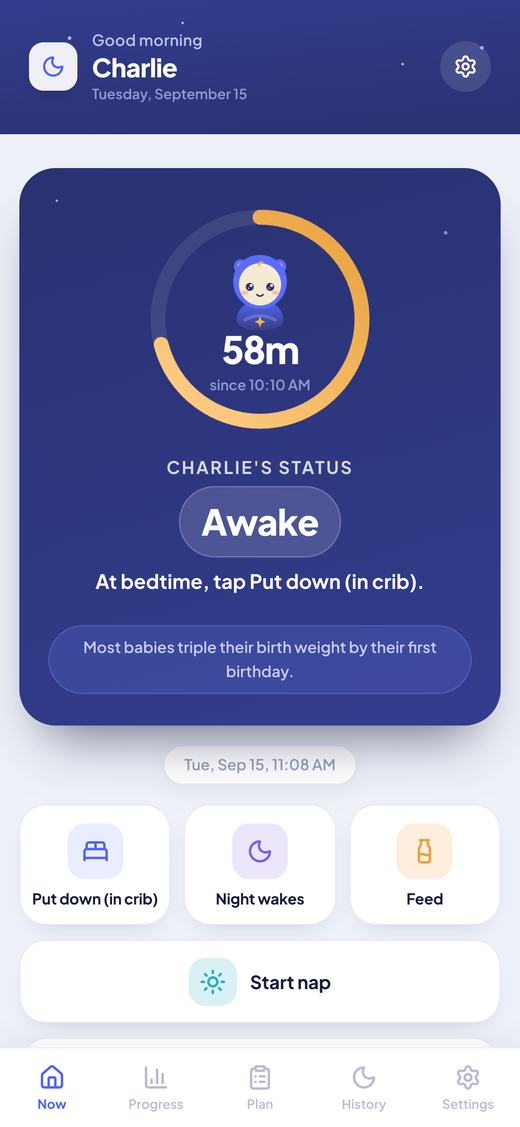
ReadTonight can be the first better night.
Two taps from here to logging. No account, no card, no setup beyond your baby's name.

Free. No ads. No in app purchases.Or use it in your browser