Sleep Sanity
Sleep training a 4 month old: what is realistic, and a gentle plan
What sleep training can and cannot do at 4 months, the regression that is probably the real problem, readiness signs, and a gentle check-in plan with feeds kept in.
Four months is the age most parents first search for sleep training, usually because sleep just fell apart. Here is what is realistic at this age, what is probably actually happening, and a gentle plan if your pediatrician agrees you are ready.
It is probably the 4 month regression
Somewhere between 3 and 5 months, babies' sleep permanently reorganises into adult style cycles, with light sleep at the end of each one. A baby who used to sleep through now surfaces every 45 to 90 minutes and needs whatever got them to sleep in the first place to get back down. This is not a phase that reverses. It is the new normal, and it is exactly why self settling starts to matter at this age. The 4 month sleep regression explains it in full.
What is realistic at 4 months
- Realistic: a consistent routine, bedtime at the right time for the age, going down awake at bedtime, a short and gentle check-in plan, and fewer wakes within a week or two.
- Not realistic: sleeping through the night with no feeds. Most 4 month olds still need one or two night feeds, and a plan that ignores that will fail or leave you with a hungry baby.
- Not yet: nap training. Naps at 4 months are still short and irregular. Work on the first nap of the day if you like, and rescue the rest.
Readiness, in your pediatrician's words
Ask three things at the 4 month visit: is weight gain on track, is there any medical reason not to, and how many night feeds does this baby still need. Those three answers shape the plan. Do not start before the visit, and do not start if your baby is small for age or has reflux that is still being managed.
A gentle plan for 4 months
- Fix the day first. Wake windows at 4 months are about 75 minutes to 2 hours. Bedtime is usually between 6:30 and 8pm. The wake window calculator gives a sample day for your baby's wake up time.
- Set a short routine. Feed, then change, then a book or a song, then into the crib awake. Keep the feed early in the routine so it stops being the thing that causes sleep.
- Use short waits. Start at 2 or 3 minutes and cap at 10 for the first week. The classic Ferber chart can be slowed down, and at this age it should be. Check-ins are a hand on the chest and a quiet phrase, 1 to 2 minutes, then out.
- Keep the feeds. Decide in daylight which wakes get a feed, usually one around 11pm to 1am and one around 3 to 4am if needed. Feed in dim light, and put down awake afterwards. Treat every other wake with the check-in plan.
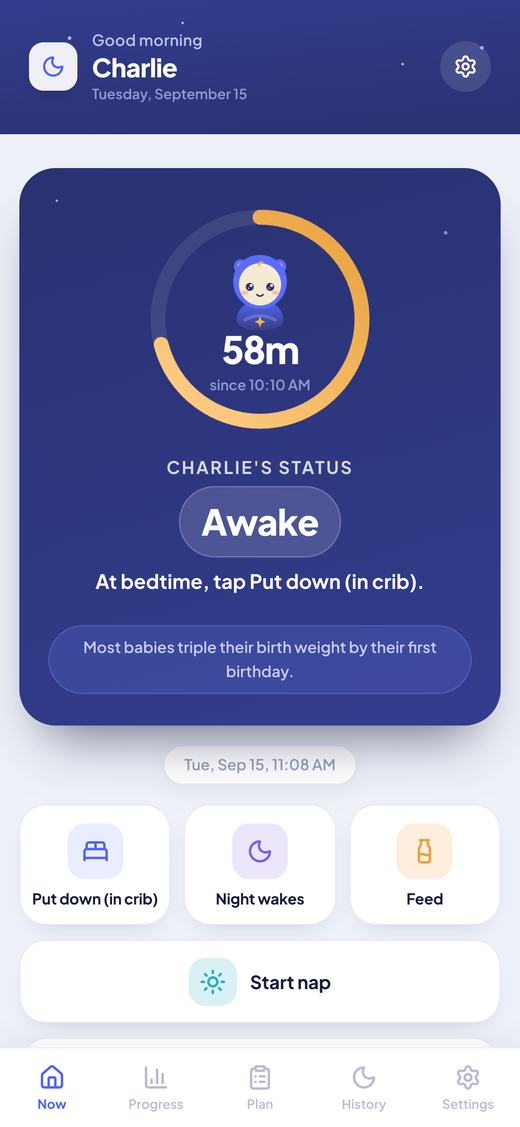
- Log it. Minutes to settle, number of wakes, longest stretch. At 4 months progress is slower and less linear than at 6 months, so you need the trend, not the memory of last night. How to log night wakes shows the one tap way.
The Sleep Sanity plan starts at 4 months with exactly this shape: touch check-ins for the first two nights, night feeds kept, and wake windows for the age band.
What to expect
A week of mixed nights, then a clearer pattern in week two. Bedtime usually improves first. Night wakes drop from four or five to one or two, with the remaining wakes being the feeds. If nothing has changed after two consistent weeks, pause and try again at 5 or 6 months, when nearly every baby is ready. There is no prize for starting early. When to start sleep training has the readiness signs.
If you would rather wait
Completely reasonable. Until then: a consistent routine, a dark room with white noise, a good bedtime for the age, and putting your baby down drowsy whenever it works without stressing when it does not. These build the foundation and often fix half the problem on their own.
FAQ
Can you sleep train a 4 month old?
Gently, yes, with your pediatrician's OK. Short waits, hands on check-ins, and night feeds kept in. Many babies respond. If yours does not within two weeks, wait and try again at 5 or 6 months.
Is 4 months too early for the Ferber method?
For the full chart, usually. For a slowed down version with waits capped at 10 minutes and feeds kept in, many pediatricians are comfortable. Ferber's own guidance leans toward 5 to 6 months.
How many night feeds does a 4 month old need?
Commonly one or two. It depends on weight, growth and daytime intake, so this is a pediatrician question. Keep the feeds the plan allows, and respond to every other wake with the check-in plan.
How long does sleep training take at 4 months?
Longer and less neatly than at 6 months. Expect a week of mixed nights and a clearer pattern in week two. Bedtime usually improves before night wakes do.
Should I sleep train during the 4 month regression?
Wait until the first chaotic week or two has passed and days are a little predictable again, then start. The regression is permanent, so there is no point waiting for it to end.
Sources
- American Academy of Pediatrics, HealthyChildren.org: Getting your baby to sleep
- Canadian Paediatric Society, Caring for Kids: Healthy sleep for your baby and child
- Mindell JA et al. Behavioral treatment of bedtime problems and night wakings in infants and young children. Sleep, 2006
- Health Canada: Safe sleep for your baby
Sleep Sanity is informational, not medical advice. Talk to your pediatrician before starting any sleep-training approach.
More from Learn
When to start sleep training: age, readiness signs and the weeks to avoid
The age most pediatricians suggest, the signs your baby is ready, the situations that make a bad week to start, and what to do if you are not there yet.
Read 7 min readToddler sleep training: 12 months to 3 years, including the crib climber
How sleep training changes after the first birthday: the one nap schedule, bedtime stalling, standing and climbing, the toddler bed question, and a check-in plan that works for toddlers.
Read 8 min readSleep training methods compared: Ferber, chair, pick up put down, fading and extinction
The five main sleep training methods side by side, how much crying each involves, how long each usually takes, and how to pick one your family can actually stick to.
ReadTonight can be the first better night.
Two taps from here to logging. No account, no card, no setup beyond your baby's name.

Free. No ads. No in app purchases.Or use it in your browser