Sleep Sanity
Wake windows by age: a simple guide
How long your baby can comfortably stay awake at each age, how to read tired cues, and how to find your own baby's real window.
A wake window is the stretch of time your baby is awake between one sleep and the next. It starts the moment they wake up and ends the moment they fall asleep again.
Most bedtime battles are a timing problem before they are anything else. Put a baby down too early and they are not tired enough to settle. Put them down too late and settling gets much harder. The window is the space in between, and it moves as your baby grows.
Typical ranges by age
Treat these as starting points, not targets. Two healthy babies the same age can sit at opposite ends of a range.
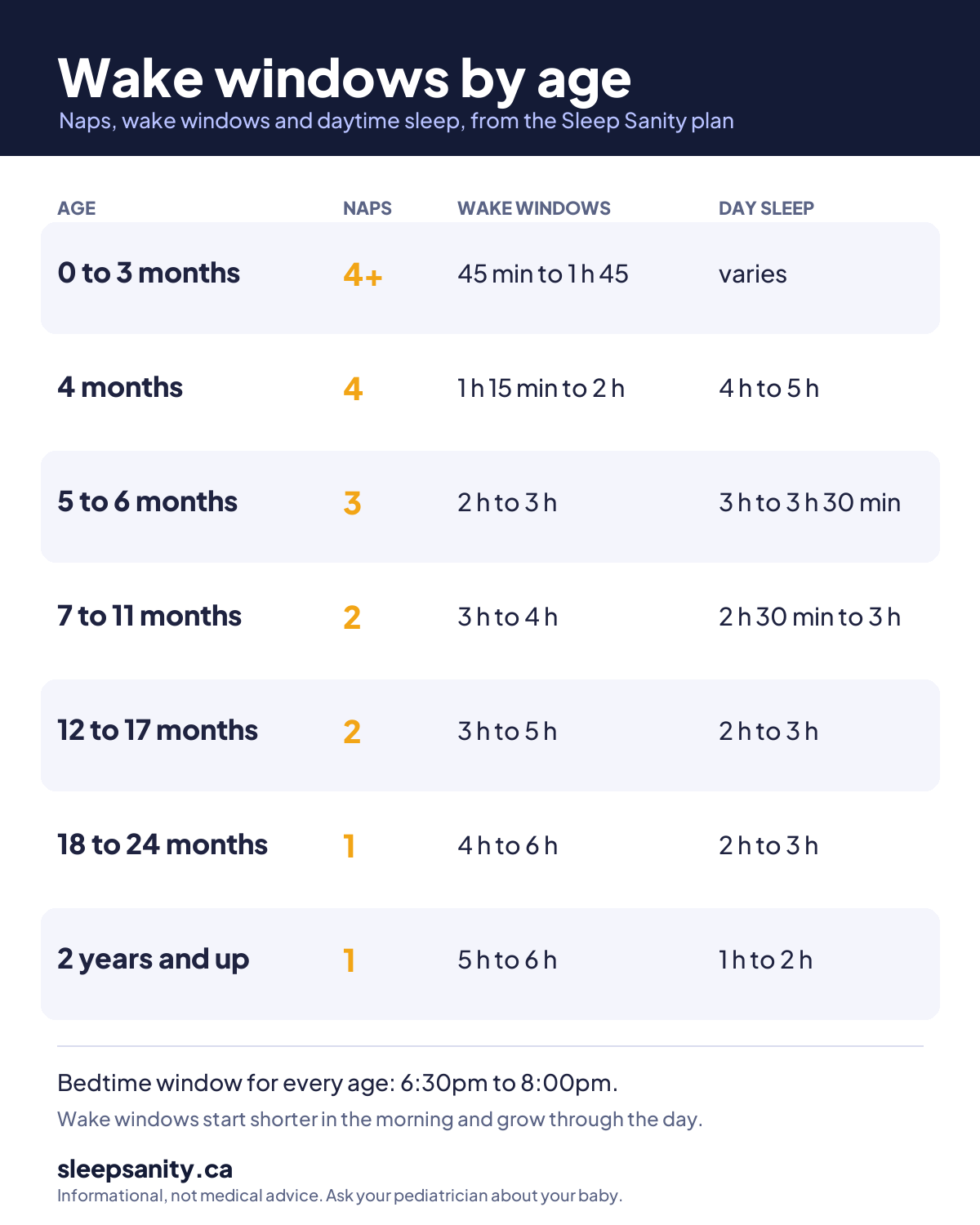
- Newborn to 3 months. Roughly 45 minutes to 1 hour 45 minutes. Many newborns cannot stay awake much past a feed and a change, and sleep is still irregular.
- 4 months. Roughly 1 hour 15 minutes to 2 hours, across about four naps.
- 5 to 6 months. Roughly 2 to 3 hours, across about three naps. The first window of the day is usually the shortest one. The window before bed is usually the longest.
- 7 to 11 months. Roughly 3 to 4 hours, across two naps. If the second nap starts falling apart, the earlier windows are often too short rather than too long.
- 12 to 17 months. Roughly 3 to 5 hours. Near the end of this range many toddlers move to one nap and the whole day gets rebuilt around it.
- 18 to 24 months. Roughly 4 to 6 hours. One long midday nap with a long stretch on either side is the usual shape.
Ranges differ between babies and between sources. Use them to get close, then let your own logs do the rest.
How to spot tired cues
Tired cues arrive in order, and the useful ones come early.
Early cues, the ones worth catching:
- Staring into the middle distance, going still, losing interest in a toy
- Slower blinking, or red rims around the eyes
- Turning away from you, or away from noise
- Gentle pulling at ears or hair
Late cues, meaning the window has already closed:
- Arching, stiffening, sudden thrashing
- Yawning, which shows up later than most people expect
- Crying that starts fast and gets loud
Start the wind down at the first early cue. If you are not seeing cues yet, start at the bottom of the age range instead. Three or four steps in the same order every time is plenty of routine.
Why overtired babies fight sleep
Staying awake past the window is stressful for a small body, and the body answers by keeping itself alert. That is why an exhausted baby can look wired, catch a second wind, and then take forty minutes to go down.
Overtired sleep also tends to be worse sleep. You often see:
- A longer, louder settle
- Naps that end after a single sleep cycle
- More wakes in the first half of the night
- An early morning wake, which shortens the next day's first window and starts the loop again
Undertired looks different. A baby who went down too early is calm, chatty and simply awake. The settle itself tells you which one you are dealing with. Calm and awake usually means too early. Frantic usually means too late.
Finding your baby's own window
Age ranges get you close. Your own logs get you the rest of the way.
- Start the nap timer when your baby wakes up, not when you put them down. The number you want is awake time, and only the timer records it honestly.
- Log each sleep when it happens, even roughly. An entry that is three minutes off beats a perfect one you never make.
- After a week, open History and pick out the sleeps that took under ten minutes to settle. Note the awake time before each of those.
- Average them. That average is your baby's current window, and it beats any chart.
Then change one thing at a time. Fifteen minutes is a big enough move to see an effect, and a small enough one that a rough night does not cost you a week. Hold the new timing for three days before you judge it, because a single night is noise.
Windows drift. Expect to repeat this every few weeks, and expect the stretch to happen fastest just before a nap drops.
What to do when the window and the clock disagree
Some days the window lands at an awkward time. A nap that should start at 4pm will push bedtime late, and a nap you skip will make bedtime a fight.
The usual answer is to shorten the last window slightly and move bedtime earlier rather than cap the nap. An earlier bedtime after a short nap day is not a lost evening. It is the thing that stops tomorrow morning starting at 5am.
When to ask someone
These ranges are general information, not a diagnosis, and they do not describe every baby.
Talk to your pediatrician if your baby is much sleepier or much harder to settle than usual, if sleep changes suddenly and stays changed, if you have feeding or weight concerns, or if anything about their breathing during sleep worries you. Where and how your baby sleeps is a separate question with its own guidance, and the AAP safe sleep pages are the right place to start.
Once your timing is steady, everything else gets easier. See how a day and a night work in the app, read what your sleep score means, or find out how to log night wakes without waking yourself up.
Want the numbers for your baby specifically? Try the wake window calculator, or print the wake windows chart for the fridge.
Sources
Sleep Sanity is informational, not medical advice. Talk to your pediatrician before starting any sleep-training approach.
More from Learn
Daylight saving time and your baby's sleep: how to handle the fall back
The clocks go back on Sunday, November 1. Three ways to shift your baby's schedule, which one to pick, and how to stop the extra hour turning into a 5am wake up.
Read 5 min readHow many naps does my baby need? A guide by age
Naps per day and total daytime sleep from 4 months to toddlerhood, the signs your baby is ready to drop a nap, and how to make the switch without wrecking bedtime.
Read 6 min readThe 4 month sleep regression: what is happening and what helps
Why a baby who was sleeping well suddenly wakes every couple of hours around 4 months, how long it lasts, and the few things that actually make it shorter.
ReadTonight can be the first better night.
Two taps from here to logging. No account, no card, no setup beyond your baby's name.

Free. No ads. No in app purchases.Or use it in your browser