Sleep Sanity
Toddler sleep training: 12 months to 3 years, including the crib climber
How sleep training changes after the first birthday: the one nap schedule, bedtime stalling, standing and climbing, the toddler bed question, and a check-in plan that works for toddlers.
Toddlers can be sleep trained. They can also stand up, shout "Mama", throw the lovey out of the crib and, eventually, climb out. The method is the same as for babies. The execution needs a few changes.
What is different after 12 months
- Sleep pressure is lower per hour awake, so timing errors show up as long, chatty bedtimes rather than crying.
- They understand far more than they can say. Explanations, a visual routine and a consistent script work in a way they cannot with a baby.
- They have practice. A 20 month old who has been rocked to sleep for 600 nights has a strong opinion about it. Expect louder protest on nights 1 to 3 and a faster turnaround after.
- Separation anxiety peaks somewhere between 12 and 18 months. Check-ins reassure, but they can also restart the protest. Voice from the door often works better than going in.
The schedule
Most toddlers move to one nap between 13 and 18 months. After the transition: wake windows of 4 to 6 hours, one nap of 1.5 to 2.5 hours starting around midday, and bedtime between 6:30 and 8pm. By 2 to 3 years, the nap shortens and bedtime may drift later. An overtired toddler is wired, not sleepy, so a too late bedtime is the most common hidden cause of a one hour bedtime battle. How many naps by age covers the transition.
The plan for toddlers
- A routine with an end. Same four or five steps every night, 20 to 30 minutes, with a clear last step ("one book, one song, lights out"). A picture chart on the wall helps from about 18 months.
- Say what will happen. "I will come and check on you. Then it is sleep time." Short, calm, the same words every night.
- Down awake, leave the room. Yes, even if they stand up. Do not stay for the standing.
- Check-ins at growing intervals. The Ferber chart works. For toddlers, go in less rather than more: a check from the doorway, the same sentence, and out. Lay them back down once, not twenty times.
- Stay consistent on requests. One more water, one more hug, the door open a bit more. Decide the answers in daylight and give the same ones every night. The requests stop within a week when they stop working.
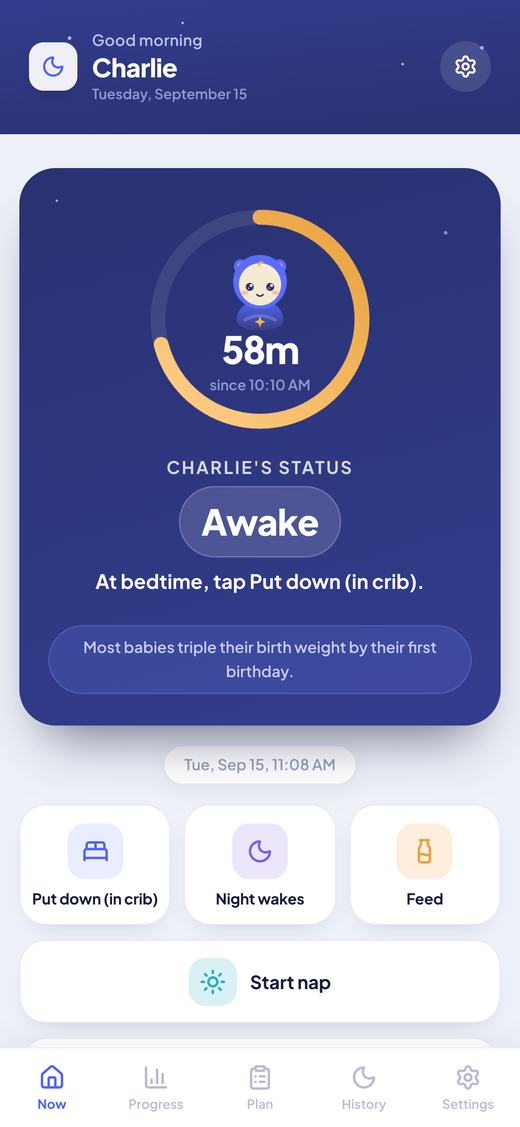
- Log the nights. Minutes to settle and number of call outs. Toddler progress is lumpy and you will want the trend. The timer keeps the intervals honest.
Standing, throwing and climbing
Standing: lay them down once at the first check-in, then leave them to it. They will sit and lie down when they are ready, and the standing stops within a few nights once it stops producing a reaction.
Throwing things out: one return at the next check-in, then nothing until morning. If it is a sleep item they genuinely need, give it back once.
Climbing out: this is a safety issue, not a sleep training one. Lower the mattress fully, remove bumpers and anything to stand on, and use a sleep sack, which makes swinging a leg over much harder. If they still get out, it is time for a bed, and the plan changes slightly.
The toddler bed question
Keep the crib as long as it is safe, ideally until close to 3. A bed removes the one physical boundary that makes check-ins simple. When you do switch, add a gate at the door, make the room fully safe, and treat leaving the room like any other protest: walk them back calmly with the same short sentence, every time, without conversation. The first few nights can involve many returns. By night 4 it is usually a handful.
Early wakes and night calls
Toddlers who have learned to fall asleep alone at bedtime mostly stop calling out at night within a week. The one that lingers is the 5am wake. Treat anything before 6am as night: no lights, no milk, the same check-in response. Early morning wakes goes through the timing fixes that usually solve it.
When to get help
Snoring, mouth breathing, pauses in breathing, or a toddler who is exhausted despite long nights are reasons to see your pediatrician before any sleep plan. So is a sudden change in sleep in a child who was sleeping well, which can be ears, reflux or a growth spurt rather than behaviour.
FAQ
Can you sleep train a 1 year old?
Yes. The method is the same as for babies: a consistent routine, down awake, and check-ins at growing intervals. Expect louder protest for the first few nights and a faster improvement after, because toddlers learn rules quickly once they are consistent.
Is it too late to sleep train a 2 year old?
No. Two year olds respond well to a visual routine, a clear script and consistent answers to bedtime requests. The hardest part is usually the parent's consistency, not the child's ability.
What do I do when my toddler stands up in the crib?
Lay them down once at the first check-in, then leave them to it. Standing stops within a few nights once it stops producing a reaction. Make sure the mattress is at its lowest setting.
Should I move my toddler to a bed to help with sleep?
Usually not. A crib is a boundary that makes sleep training simpler. Move to a bed when climbing out makes the crib unsafe, or close to age 3, and add a gate at the door when you do.
How long does toddler sleep training take?
Bedtime typically improves within three to seven nights. Night calls stop within a week or two. Early wakes can take longer and are mostly a timing problem.
Sources
- American Academy of Pediatrics, HealthyChildren.org: Healthy sleep habits, how many hours does your child need
- Canadian Paediatric Society, Caring for Kids: Healthy sleep for your baby and child
- Mindell JA et al. Behavioral treatment of bedtime problems and night wakings in infants and young children. Sleep, 2006
- Ferber, R. Solve Your Child's Sleep Problems, revised edition (2006)
Sleep Sanity is informational, not medical advice. Talk to your pediatrician before starting any sleep-training approach.
More from Learn
When to start sleep training: age, readiness signs and the weeks to avoid
The age most pediatricians suggest, the signs your baby is ready, the situations that make a bad week to start, and what to do if you are not there yet.
Read 8 min readSleep training methods compared: Ferber, chair, pick up put down, fading and extinction
The five main sleep training methods side by side, how much crying each involves, how long each usually takes, and how to pick one your family can actually stick to.
Read 6 min readSleep training a 6 month old: the schedule, the plan and the first week
Why 6 months is the easiest age to sleep train, the schedule that makes it work, a night by night plan with the Ferber chart, and what the first week usually looks like.
ReadTonight can be the first better night.
Two taps from here to logging. No account, no card, no setup beyond your baby's name.

Free. No ads. No in app purchases.Or use it in your browser