Sleep Sanity
What a baby sleep app should actually do (and the features to ignore)
How to judge a baby sleep app before you depend on it at 3am. The five things that matter, the features that are mostly noise, and the questions to ask about your data.
Most baby sleep apps are built to be impressive in the App Store screenshots. Very few are built for the moment you will actually use them: half asleep, one handed, in the dark, with a crying baby in the other arm. This guide is how we think about it, written by people who built one, so take the bias into account and judge the reasoning on its own.
The five things that matter
1. Logging has to be one tap
At 3am you will not fill in a form. If logging a wake takes a start time, an end time, a mood and a note, you will do it for two nights and then stop, and an empty log is worth nothing. The test: can you record "baby woke up" with one thumb, without looking properly, in under two seconds? If the app needs you to pick a time from a wheel, it has already failed the test.
2. It should turn the log into a number
Raw timestamps do not help a tired parent. What you need in the morning is a single answer to "was that better or worse than last week?" That means the app has to compute time to fall asleep, number of wakes, longest stretch and total sleep, and then summarise them. What a sleep score means explains the approach we use. The specific formula matters less than having one, because a trend line is what stops you from giving up on night 3.
3. It should tell you what to do tonight
Tracking without a plan is just a diary. A good app knows your baby's age, suggests wake windows and a bedtime window, and, if you are sleep training, counts the check-in intervals so nobody is staring at a clock. If the plan is based on a recognised approach like the Ferber method, it should say so and explain it rather than hide it behind a brand name.
4. Both parents need the same night
Sleep is a team sport. If one parent takes the first shift and the other takes 3am onward, the log has to live on both phones and update in real time. An app that only works on one device guarantees two half records and an argument about how many times the baby actually woke.
5. It has to work when the internet does not
Nurseries have bad signal. Phones go into low power mode. The app should log locally first and sync later, so a tap at 2am is never lost to a spinner. Offline first is also the honest answer to privacy, because data that stays on your phone cannot leak from a server.
Features that are mostly noise
- Sound detection and "AI cry analysis". Fun to try, rarely accurate enough to act on, and a reason to keep the phone in the nursery pointed at your baby all night.
- Predicted sleep times to the minute. Babies do not run on predictions. Wake window ranges are useful; a notification that says "nap at 10:42" is not.
- Gamification. Streaks and badges for a parent who has slept four hours are an insult, not a motivator.
- Social feeds and community. You can get that from a group chat. It does not belong in the tool you open in the dark.
- A paywall in front of your own history. If the app charges to show you last month's data, you do not own your log.
Questions to ask about your data
A baby sleep log is a detailed record of when your family is awake, asleep and at home. Before you commit, check:
- Does it work without an account? If yes, your data starts on your phone and goes nowhere unless you choose.
- What happens when you delete your account? The answer should be that everything is deleted, and it should be in the privacy policy.
- Are there advertising or tracking SDKs in the app? The App Store privacy label and Google Play's data safety section tell you.
- Can you export your data? A CSV is enough.
What we built
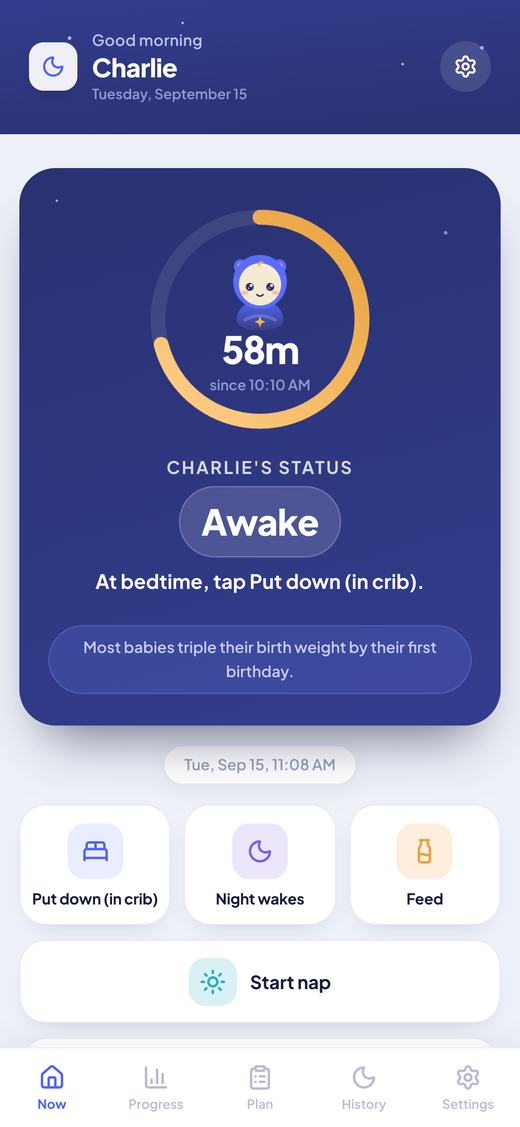
Sleep Sanity is our attempt at the list above: four big buttons for the night, a 0 to 100 score each morning, an age based plan with Ferber style check-ins counted for you, two phones on one shared night, offline first, no account required, no ads and no tracking SDKs. It is free on iPhone and Android and runs in a browser too. If another app does these five things better for your family, use that one. The point is the five things.
FAQ
What is the best baby sleep app?
The one you will still be using on night 10. In practice that means one tap logging, a clear summary each morning, a plan for tonight, sync between both parents and offline support. Judge any app, including ours, against those five.
Are baby sleep apps worth it?
Yes if they replace a notes app and a memory argument with a trend you can read. No if they add a form to fill in at 3am. The value is in the pattern you see after a week, not in any single night's entry.
Is there a free baby sleep tracker with no subscription?
Sleep Sanity is free on iPhone, Android and the web today, with no ads or in app purchases. Several other trackers have free tiers with limits on history or sync. Check what the free tier hides before you build a month of data in it.
Do baby sleep apps work for sleep training?
They work as a logbook and a timer, which is most of what sleep training needs from a tool. The method does the rest. Look for an app that explains its plan and counts the check-in intervals rather than one that just tracks.
Can two parents use the same baby sleep app?
With the right app, yes. Look for household sync or a shared account that puts the same night on both phones in real time, so whoever is on duty has the full picture.
Sources
Sleep Sanity is informational, not medical advice. Talk to your pediatrician before starting any sleep-training approach.
More from Learn
When to start sleep training: age, readiness signs and the weeks to avoid
The age most pediatricians suggest, the signs your baby is ready, the situations that make a bad week to start, and what to do if you are not there yet.
Read 7 min readToddler sleep training: 12 months to 3 years, including the crib climber
How sleep training changes after the first birthday: the one nap schedule, bedtime stalling, standing and climbing, the toddler bed question, and a check-in plan that works for toddlers.
Read 8 min readSleep training methods compared: Ferber, chair, pick up put down, fading and extinction
The five main sleep training methods side by side, how much crying each involves, how long each usually takes, and how to pick one your family can actually stick to.
ReadTonight can be the first better night.
Two taps from here to logging. No account, no card, no setup beyond your baby's name.

Free. No ads. No in app purchases.Or use it in your browser